Bob Dylan, Australian tour, 1966
| Australian tour 1966 | Blowing in the Mind 1967 | Brett Whiteley & Dylan | Don't Look Back 1967 | Film Script | London 1962-3 | Masters of War |
 |
| Autographed flyer. |
Contents
- Introduction
- Arrival & Interview
- Tour Dates
- Recordings
- References
-------------------
April 13, 1966 - Starting with a show in Sydney, Australia, Dylan embarks on a combative tour of Australia and Europe, playing for audiences who are surprised by his electric music. Many of the concerts become battlegrounds with fans both booing and cheering Dylan’s new sound. The concerts were filmed by cinéma vérité pioneer, D.A. Pennebaker, whose movie, Don't Look Back, documented Dylan’s tour the previous year. Languishing for years, the footage of these remarkable shows is finally brought to light in Martin Scorsese’s 2005 award-winning film about Dylan’s life, No Direction Home. (Bob Dylan, Facebook, 14 April 2021)
1. Introduction
Bob Dylan's acoustic / electric world tour of 1966 with The Hawks (later The Band) saw dates in Australian during April of 1966. As with the infamous tour of England the previous year, recorded in the D.A. Pennebaker film Don't Look Back, the artist and musician was met with an often angry reception by those who took exception to the electrification of his music. Dylan was seen as a folk artist, pure and simple - out there on stage alone, with just a guitar and harmonica, a unique voice, and his incredible music (words and sound). Any variation from that was seen as a betrayal by fans, and even by some of his fellow musicians. There are numerous accounts of the latter, and it was unfortunate that people in Australia not only felt the same, but saw the need to copy their fellow English "fans" and express their disdain publically, both in the media and at his concerts. On the positive side, the way Dylan dealt with critics and detractors was to reject them and their attacks. He did not waiver from his course. For example, at his initial Sydney interview the following took place:
 |
| Shoeless upon arrival in OZ, 1966. |
Interviewer: How would you describe yourself?
Dylan: I wouldn't.
This dismissive, impossible to pin down attitude would stay with Dylan for the remainder of his career - often frustrating to journalists and the media, and at the same time inspirational for the fans and fellow artists.
The following is a brief account of elements of the Australian tour of 1966 in which the slogan: Nobody Sings Dylan Like Dylan was used in promotional material by his label Columbia / the Australian Record Company Limited. This, of course, was a pointed reference to the fact that many musically conservative individuals thought Dylan could not actually sing when he first came to prominence around 1963, at least in the traditional manner, such was the unique nature of his vocalisation. With The Beatles hitting the charts on both sides of the continent at the same time, this youthful assault on conservative values was overwhelming, and Bob Dylan remained at the forefront of if through to the end of the decade.
Dylan would visit Australia on a number of occasions - always engaging with the media in his confrontational defensive manner, and always presenting something slightly different to his audiences. The present writer remembers seeing a distant, white suit clad Dylan at a rain-soaked, muddy, Sydney open air concert back in the 1990s. It was not impressive at all, but it was important to be there nevertheless. Realising that forever the early, purely acoustic material would remain a personal favourite, shock still came with the release of Time out of Mind in 1997 - #22 on his greatest album list - and the enchantment with songs such as Love Sick. The young man who had raged against the machine back in 1962 with Masters of War, was now the elderly master songwriter, pining, like us all, for love. What a legend.
-----------------------
2. Arrival & Interview
Bob Dylan arrived in Sydney, Australia on 12 April 1966. In the following video clip, the first 26 seconds shows this, whilst the rest is him arriving in Stockholm, Sweden, followed by audio is from an undated interview recorded when Dylan was in Australia at the time. The recording of Ballad Of A Thin Man at the end was recorded in Sydney on April 13, 1966.
Bob Dylan arriving in Australia, 12 April 1966, YouTube, duration: 2.05 minutes.
The following is audio of the original press conference held at Sydney airport upon his arrival and as recorded by Sydney radio station 2GB.
 |
| Bob Dylan, interview in Australia, 1966, National Film & Sound Archive of Australia, YouTube, duration: 4.01 minutes. |
Australia press and media were notorious from the 1960s through to the new millennium for asking inane and stupid questions of visitors to the country. Dylan would be no exception during his visits over the year, though the press grew wary of his wit and disdain for them.
* Craig McGregor, Sydney Morning Herald, 13 April 1966:
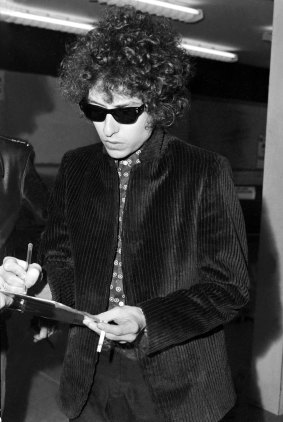
Looking rather like an extra from "The Ten Commandments," Mr Bob Dylan arrived in Sydney yesterday and within half an hour had conducted an anti-interview, put down the Press — and parodied the whole performance. Dylan disappointed none of his disciples who crowded into the reception room at Kingsford Smith Airport to hear him. Dressed conservatively in a black corduroy suit, black suede high-heeled calf-length zipper-sided boots, dark glasses and long ringleted hair, Dylan disembarked from the airliner accompanied by the five members of his band dressed even more conservatively in a variety of dark glasses and black sombreros, and the greying bulk of his manager, Albert Grossman.
 |
| Singer Bob Dylan arrives at Sydney's Mascot Airport on 12 April 1966. Credit: Trevor Dallen. |
After the Customs check, Dylan was besieged by autograph hunters in camel-hair jeans, Toulouse-Lautrec blazers and Viva Zapata moustaches. He obligingly signed himself "The Phantom" and accepted a pop-art envelope containing a letter made of newspaper and magazine cuttings. He settled himself down for the Press conference and it was clear that the questioners had made up their minds that Dylan was either a protest singer with a message or a phony, or maybe both, and they weren' t going to be put off by any of that jazz about his just being a person who writes songs. Questions and answers followed.
 |
| Singer Bob Dylan speaks to reporters at Sydney's Mascot Airport on 12 April 1966. Credit: Trevor Dallen. |
[Q] "Are you a protest singer?"
[BD] "I haven't heard that word for a long time. Everybody knows that there are no protest songs any longer — it's just songs."
[Q] "If you aren't a protest singer why does everybody say you are?"
[BD] "Everybody? Who does?"
[Q] "'Time' magazine."
[BD] "Oh, yeah."
[Q] "Why have you started playing rock 'n' roll?"
[BD] "Is that what they call it?"
[Q] "Why have you gone commercial?"
[BD] "I have not gone commercial, I deny it" (with Bible-swearing hand upraised). "Commercial - that's a word that describes old grandmothers that have no place to go."
[Q] "Are you a professional beatnik?"
[BD] "Huh?"
[Q] "Are you a professional beatnik?"
[BD] "Well, I was in the brigade once - you know, we used to get paid money — but they didn't pay me, so I became a singer."
[Q] "Why do you wear these outlandish clothes?"
[BD] "I look very normal where I live, I'm conservative by their standards,"
[Q] "Does it take a lot of trouble to get your hair like that?"
[BD] "No, you just have to sleep on it for about 20 years."
[Q] "What would you be if you weren't a songwriter?"
[BD] "A ditchdigger called Joe."
In a 2014 interview with the ABC, ex-Herald journalist Craig McGregor revealed that following the publication of this article he was invited to a private hotel meeting with Bob Dylan, where the songwriter played him a test pressing of his next album, 'Blonde on Blonde'. The two remained in touch over the years, and McGregor later edited the book 'Bob Dylan: A retrospective'.
-------------------
3. The Tour Dates
The Australian tour extended over 11 days, with 7 concerts in five capital cities - two each in Sydney and Melbourne, and 1 each in Brisbane, Adelaide and Perth. All concerts were listed as commencing at 8.15pm and ran for approximately 90 minutes, with a split between the opening acoustic set by Dylan, followed by a combined electric set with The Hawks.
Wednesday, 13 April - Sydney Stadium. See also 16 April. The show was recorded for Sydney television station TCN(, but the footage is believed lost. The audio has, however, survived in toto. Also lost is a solo appearance on TCN9 where Dylan performed Desolation Row. The audio for this was released by Dylan in 2018.
 |
| Sydney Stadium, 13 April 1966. |
* Bob Dylan live at the Sydney Stadium, 1966, ShawwnF, YouTube, duration: 96.53 minutes. Audio.
* Desolation Row, Live on TCN9 TV, Sydney, April 1966, duration: 10.36 minutes. Audio.
Friday, 15 April - Festival Hall, Brisbane
Saturday, 16 April - Sydney Stadium
Tuesday, 19 April - Melbourne Festival Hall
* Radio interview with Stan Rolfe in Melbourne, April 1966, YouTube, duration: 7.32 minutes. Audio.
* Live footage of Bob Dylan in Melbourne, Australia, 1966, YouTube, duration: 2.21 minutes. Video.
Wednesday, 20 April - Melbourne Festival Hall
Friday, 22 April - Adelaide Palais Royal
* Interview, Adelaide, 1966, YouTube, duration: 12.43 minutes.
Saturday, 23 April - Perth Capital Theatre
Signed by Dylan on 4/23/1966… Rosemary had told us she knew Dylan, she asked us for our programs, handed them to Bob Dylan and asked him to sign them, much to my excitement. 'Love' was an almost unbearable touch!
Most of Dylan and The Hawks' performances from 1965-66 are best remembered for the vicious catcalls from the audience, as seen in the Don't Look Back film footage by D.A. Pennebaker of the 1965 British tour. These also occurred in Australia during 1966.
 |
| Phil Wallace: In the early 60s I was a member of The Bob Dylan Appreciation Society of Australasia and the girl who ran the group sent me these 2 photos from the tour. (Facebook 17 April 2021) |
-------------------
4. Recordings
Columbia recorded many of the concerts on this tour, including those from Australia. They were later release during ..... and some are freely available on YouTube.

* Bob Dylan - The 1966 Live Recordings, 36 CD, Sony, 2016, 1,777 minutes. The 2LP set Bob Dylan Live In Sydney 1966' is the first time that Bob Dylan's concert, recorded on 13 April 1966 at the Sydney Stadium, has been available as an official Bob Dylan release. This first concert of his 1966 World Tour outside of the US was released as a one-pressing only limited edition 2LP-set. The show was originally recorded by TCN9 for television broadcast, and is one of the only recordings from the 1966 tour that still exists in it's entirety. Dylan is accompanied on these recordings by Robbie Robertson (guitar), Rick Danko (bass, backing vocals), Richard Manuel (piano), Garth Hudson (organ) and Mickey Jones (drums). The Australian content includes the following from the Sydney and Melbourne concerts:
* Disc 1 – Sydney, Australia, 13 April 1966 (Soundboard recorded by TCN 9 TV Australia)
- She Belongs to Me 3.17
- She Belongs to Me 4.34
- Visions of Johanna 7.42
- It's All Over Now, Baby Blue 5.57
- Desolation Row" 10.49
- Just Like a Woman 5.24
- Mr. Tambourine Man 7.46 Total = 45.29
* Disc 2 – Sydney, Australia, 13 April 1966 (Soundboard recorded by TCN 9 TV Australia)
- Tell Me, Momma 4.28
- I Don't Believe You (She Acts Like We Never Have Met) 5.52
- Baby, Let Me Follow You Down 4.03
- Just Like Tom Thumb's Blues 6.51
- Leopard-Skin Pill-Box Hat 4.37
- One Too Many Mornings 3.30
- Ballad of a Thin Man 7.13
- Positively 4th Street 4.53 Total = 41.27
* Disc 3 – Melbourne, Australia, 20 April 1966 (soundboard tracks 1–6 / unknown broadcast tracks 7–9)
- She Belongs to Me 2.57 Incomplete
- Fourth Time Around 5.25
- Visions of Johanna 9.57
- It's All Over Now, Baby Blue 6.00
- Desolation Row 12.10
- Just Like a Woman 6.00
- Tell Me, Momma 1.38 Fragment
- Baby, Let Me Follow You Down 3.18
- Just Like Tom Thumb's Blues 6.46 Total = 54.11
* Disc 35 – Melbourne, Australia, 19 April 1966 (Audience tape)
- She Belongs to Me 3.40
- Fourth Time Around 4.49
- Visions of Johanna 7.39
- It's All Over Now, Baby Blue 5.30
- Desolation Row 9.27
- Just Like a Woman 5.56
- Mr. Tambourine Man 7.46
- Tell Me, Momma 4.11
- I Don't Believe You (She Acts Like We Never Have Met) 5.34
- Baby, Let Me Follow You Down 3.50
- Just Like Tom Thumb's Blues 0.13 Fragment
- Leopard-Skin Pill-Box Hat Total = 64.18
* Bob Dylan live at the Sydney Stadium, 1966, ShawwnF, YouTube, duration: 96.53 minutes.
Track listing: 0:00 She Belongs to Me 3:42 Fourth Time Around 8:22 Visions of Johanna 16:37 Its All Over Now Baby Blue 22:47 Desolation Row 33:45 Just Like a Women 39:07 Mr Tambourine Ma 51:45 Tell Me, Momma 56:55 I Don't Believe You 1:03:20 Baby Let Me Follow You Down 1:08:55 Just Like Tom Thumb's Blues 1:15:05 Leopard Skin Pill Box Hat 1:19:50 One Too Many Mornings 1:23:25 Ballad Of a Thin Man 1:30:45 Positively 4th Street.
* Melbourne Festival Hall, 19 or 20 April 1966, duration: 63.53 minutes. Unofficial bootleg. Also issued under the title The Children's Crusade.
Track listing: 1 She Belongs To Me, 2 Fourth Time Around, 3 Visions Of Johanna, 4 It's All Over Now Baby Blue, 5 Desolation Row, 6 Just Like A Woman, 7 Baby Let Me Follow You Down, 8 Just Like Tom Thumb's Blues, 9 Tell Me Mama, 10 Like A Rolling Stone.
No bootlegs from the other 1966 Australian concerts are at present known to the writer.
--------------------
5. References
Bannerman, Mark, From Sydney to New York: Craig McGregor's decades documenting Bob Dylan, ABC News, Sydney, 16 August 2014.
Dylan, Bob and Howard Alk (directors) and D.A. Pennebaker (cinematographer), Eat the Document [1966 World Tour, Europe], 52 minutes, 1972. Unreleased.
Jones, Mickey, The Home Movies - Bob Dylan's World Tour 1966, BingeWorthy Documentaries, YouTube, duration: 95.55 minutes. Comment: With a set of drums and an 8mm color home movie camera, Mickey Jones toured the world in 1966 with Bob Dylan and The Band. He filmed "The tour that changed Rock and Roll forever" and the booing crowds, scathing reviews, stomping feet, and infamous catcall of "Judas!" in response to Dylan trading in his acoustic folk guitar for an electric. Now, drummer-turned-actor Mickey Jones, with Director Joel Gilbert, chronicles the legendary 1966 Bob Dylan World Tour through his recently discovered home movies. This updated release includes new, exclusive interviews with Charlie Daniels, Johnny Rivers, Trini Lopez, soundman Richard Alderson, and new insights by Mickey Jones.
Pennebaker, D.A. (director), Don't Look Back [1965 British tour], Leacock-Pennebaker Inc., 1967, 96 minutes.
The Children's Crusade, Melbourne Festival Hall, 1966, Bootleg recording.

Tour Programme, 1966.


Wikipedia, Bob Dylan World tour 1966, Wikipedia, accessed 27 November 2025.
-----, The Hawks, Wikipedia, accessed 27 November 2025.

------------------
| Australian tour 1966 | Blowing in the Mind 1967 | Brett Whiteley & Dylan | Don't Look Back 1967 | Film Script | London 1962-3 | Masters of War |
Last updated; 4 March 2026
Michael Organ, Australia


Comments
Post a Comment